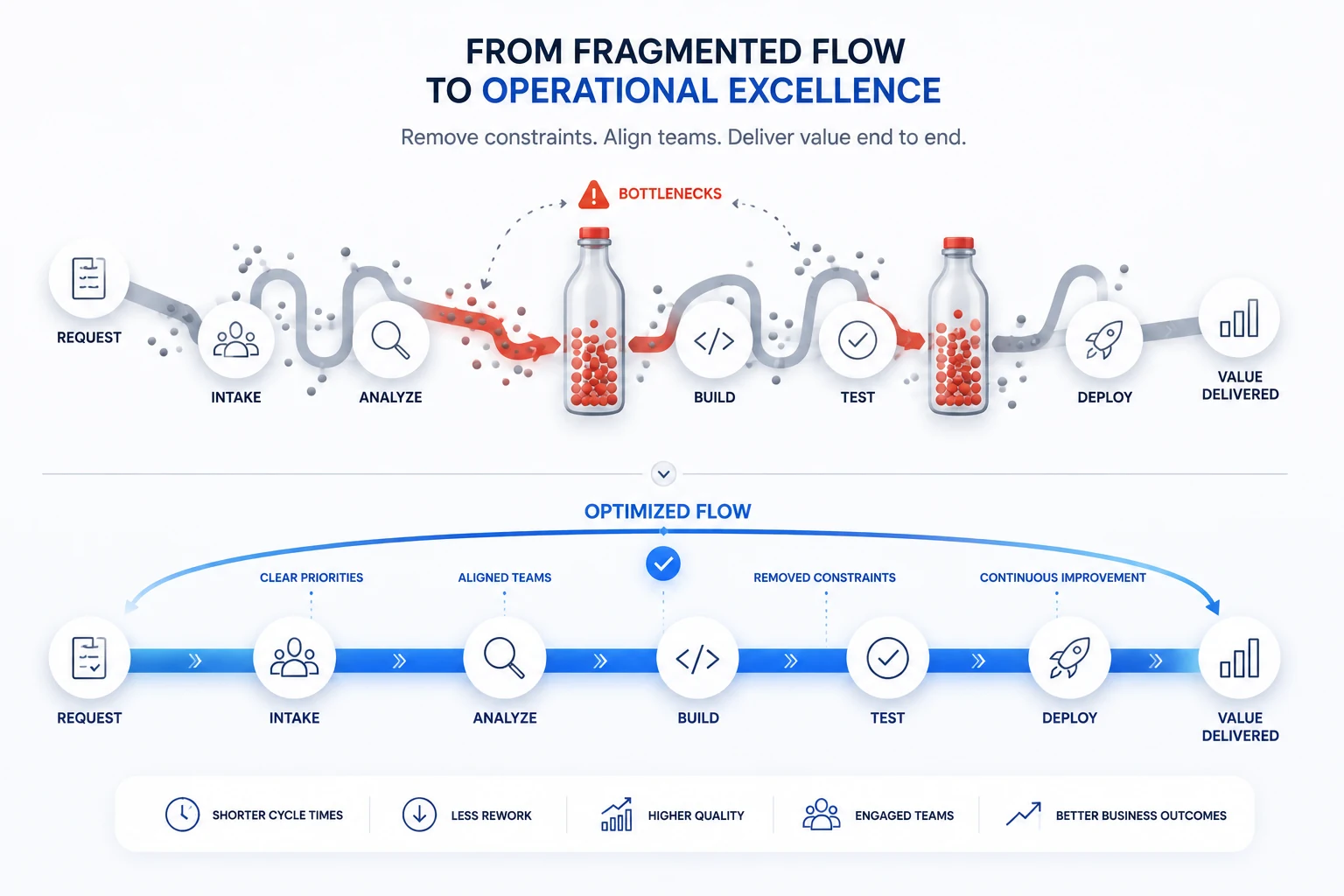
When executives talk about operational excellence, the conversation usually moves quickly to efficiency — cost reduction targets, process automation, headcount optimization. These are legitimate objectives. But they are outputs, not starting points.
Organizations that pursue efficiency without first understanding flow end up optimizing the wrong things. They reduce headcount in the wrong places, automate processes that were already broken, and measure productivity in ways that obscure the actual constraints on business performance. The efficiency gains are real but shallow. The underlying operational problems remain.
Operational excellence — the kind that compounds over time and translates reliably into business results — starts with a different question: how does work actually flow?
Why Operational Excellence Starts With Flow
Flow is the movement of work across people, teams, decisions, and systems. In most organizations, this movement is poorly understood and poorly managed. Work accumulates in queues. Decisions wait for escalation. Handoffs are unclear. Dependencies are undocumented. Priorities shift faster than work can be sequenced and completed.
In this environment, local efficiency improvements produce surprisingly little value. A team that completes its tasks faster while waiting for upstream input has not improved the flow of value — it has improved the appearance of productivity. The constraint lies elsewhere in the system.
Research on organizational performance improvement consistently shows that the highest-leverage interventions are almost never in individual task efficiency. They are in the system-level constraints that govern how work moves: handoff quality, decision latency, priority clarity, and the feedback loops that allow the system to self-correct.
Understanding flow means mapping work as a system — identifying where it moves cleanly, where it accumulates, where decisions stall it, and where organizational structure creates the friction that teams absorb daily without being able to name.
In banking and financial services — where regulatory approval chains, compliance workflows and risk governance requirements are part of the operating structure — distinguishing between necessary oversight and avoidable coordination friction is often where the most consequential flow improvement work begins.
The Hidden Cost of Fragmented Work
Fragmented work is the most common and most underestimated source of operational underperformance. It occurs when work that should move continuously across a team or a value stream is interrupted by unclear ownership, competing priorities, approval dependencies, or coordination overhead.
The direct cost is visible in delay and rework. Work stops, restarts, and often has to be partially redone when context is lost during the interruption. But the indirect cost is often larger: the cognitive overhead of managing fragmented work absorbs the organizational attention that should be directed at solving problems and improving outcomes.
Teams in high-fragmentation environments spend a disproportionate amount of their capacity on coordination — tracking status, managing escalations, clarifying who owns what. This is invisible on most management dashboards because it looks like activity. But it is not work progressing toward outcomes. It is the tax that fragmented operating structures impose on every person trying to get things done.
McKinsey’s research on organizational health identifies coordination friction and unclear decision rights as significant drains on organizational execution capacity — contributing to slower delivery, higher costs, and reduced responsiveness to change.
The hidden cost of fragmented work is not just inefficiency. It is the accumulated organizational fatigue that makes improvement programs harder to sustain and behavioral change harder to embed.
What Flow Discipline Requires
Flow discipline is the organizational capacity to understand, manage, and continuously improve how work moves through the system. It is not a methodology. It is a set of practices, structures, and decision habits that together make the operating system visible and improvable.
Work visibility. Teams cannot improve what they cannot see. Flow discipline starts with making the status, movement, and constraints of active work visible across the system — not just within individual teams or functions. This means shared boards, clear work-in-progress limits, and operating rhythms designed to surface flow problems before they become crises.
Explicit prioritization. Flow breaks down when teams are expected to work on multiple competing priorities simultaneously. Explicit prioritization — clear, current, and shared — reduces the switching cost and coordination overhead that fragment work. It also creates accountability: when priorities are explicit, it becomes visible when the system is overloaded.
Constraint identification. In any operating system, a small number of constraints govern the speed and quality of the whole. Flow discipline requires identifying these constraints systematically — not assuming that the loudest problem is the most important one — and directing improvement energy toward the points of highest leverage.
Decision latency management. Decisions are often the least visible form of work in progress and the most damaging source of flow delay. When decisions wait for escalation, approval, or meeting cycles, work downstream stacks up. Flow discipline requires mapping decision points, identifying where latency accumulates, and redesigning decision structures to match the tempo of the work they govern.
Feedback loop design. Systems improve when they can learn from their own performance. Building short feedback loops into operating rhythms — daily, weekly, and cycle-level retrospectives that focus on system behavior rather than individual performance — creates the organizational capacity for continuous improvement.
How Leaders Should Improve Execution
Operational improvement programs fail most often because the organizational conditions for sustained improvement are absent — not because the techniques are wrong. Leaders commission Lean or Six Sigma programs, invest in process redesign, and appoint improvement leads. But without the structural conditions that allow improvement to embed and compound, gains dissipate when the program ends.
The structural conditions for sustained operational improvement include:
Psychological safety for surfacing problems. Teams that see problems but do not surface them — because surfacing problems is associated with blame rather than resolution — cannot improve. Creating the norm that surfacing flow problems is valued behavior is a leadership responsibility, not a training intervention.
Governance that manages the system, not just the tasks. Most operational governance focuses on task completion: are teams hitting their sprint goals, their delivery targets, their SLAs? System governance asks different questions: is the operating system improving? Are constraints being resolved or just managed? Are feedback loops functioning?
Leadership engagement with the work level. Flow problems are often visible at the work level long before they appear in management reports. Leaders who engage with teams where work actually happens — in operating reviews, stand-ups, or structured walkthroughs of active work — build a much more accurate picture of where the system is under stress.
The Operational Excellence insights hub offers additional perspectives on execution governance, flow management, and the organizational disciplines that sustain improvement. For organizations building or resetting their operational improvement capability, advisory engagements offer structured support for exactly this kind of diagnostic and design work.
Where to Start
The right starting point for most operational improvement efforts is not a process redesign. It is a flow diagnostic — a structured look at how work actually moves through the system today, where it accumulates, and where the highest-leverage improvement opportunities lie.
This means mapping the primary value streams or workflows that matter most to business outcomes, observing where work stalls and why, identifying the decision points that introduce the most delay, and understanding where priority fragmentation is absorbing organizational capacity.
From that diagnostic, the improvement agenda becomes visible — and, more importantly, sequenced. Not all operational problems are equal. The ones that constrain flow most severely deserve attention first, regardless of where they sit in the organizational hierarchy.
Organizations that start with flow understanding before efficiency targeting build the diagnostic foundation for improvement that compounds over time. Those that start with efficiency targets often find themselves optimizing the wrong things — and wondering why the results do not match the investment.
If your organization is facing operational challenges that resist standard improvement approaches, a flow discipline lens may reveal the structural issues that are preventing progress. Reach out to explore what that diagnostic might look like in your context.
Conclusion and Recommendations
Operational excellence is not an efficiency program. It is a discipline — the organizational capacity to understand how work flows, identify where it stalls, and build the practices and structures that allow the operating system to improve continuously.
For leaders building or resetting an operational excellence capability, the following recommendations provide a practical starting framework:
Start with a flow diagnostic, not an efficiency target. Map how work actually moves through the system before setting improvement targets. Efficiency gains in the wrong places produce activity without impact. Flow understanding reveals where the highest-leverage interventions lie.
Make work visible across the system. Individual team visibility is not enough. The flow problems that matter most occur at handoffs and dependencies between teams. Shared visibility into work status and movement is a prerequisite for system-level improvement.
Manage decision latency explicitly. Map the decision points in your primary workflows and identify where latency accumulates. Redesign decision structures to match the tempo of the work they govern — not the calendar of available governance meetings.
Build short feedback loops into operating rhythms. Improvement that compounds requires learning that is rapid and structured. Short feedback cycles — focused on system behavior, not individual performance — create the organizational muscle memory for continuous improvement.
Govern the system, not just the tasks. Shift at least part of your operational governance from task-completion reporting to system-health assessment: are constraints being resolved, are feedback loops functioning, is the operating system improving?
These are not methodological prescriptions. They are the structural conditions that allow operational improvement to embed and compound rather than plateau after initial gains.
Explore more perspectives in the Operational Excellence insights hub or browse all strategic insights. For related thinking on how execution discipline connects to broader transformation strategy, see Digital Transformation Is an Execution System. To discuss what operational improvement looks like in your organization, advisory engagements are the right starting point.