The ambition behind most digital transformation programs is genuine. Executives see the competitive pressure. Boards approve the investment. Leaders commission the strategy. And then, somewhere between the strategy presentation and the business outcomes, the momentum breaks down.
This is not a failure of ambition. It is a failure of execution architecture.
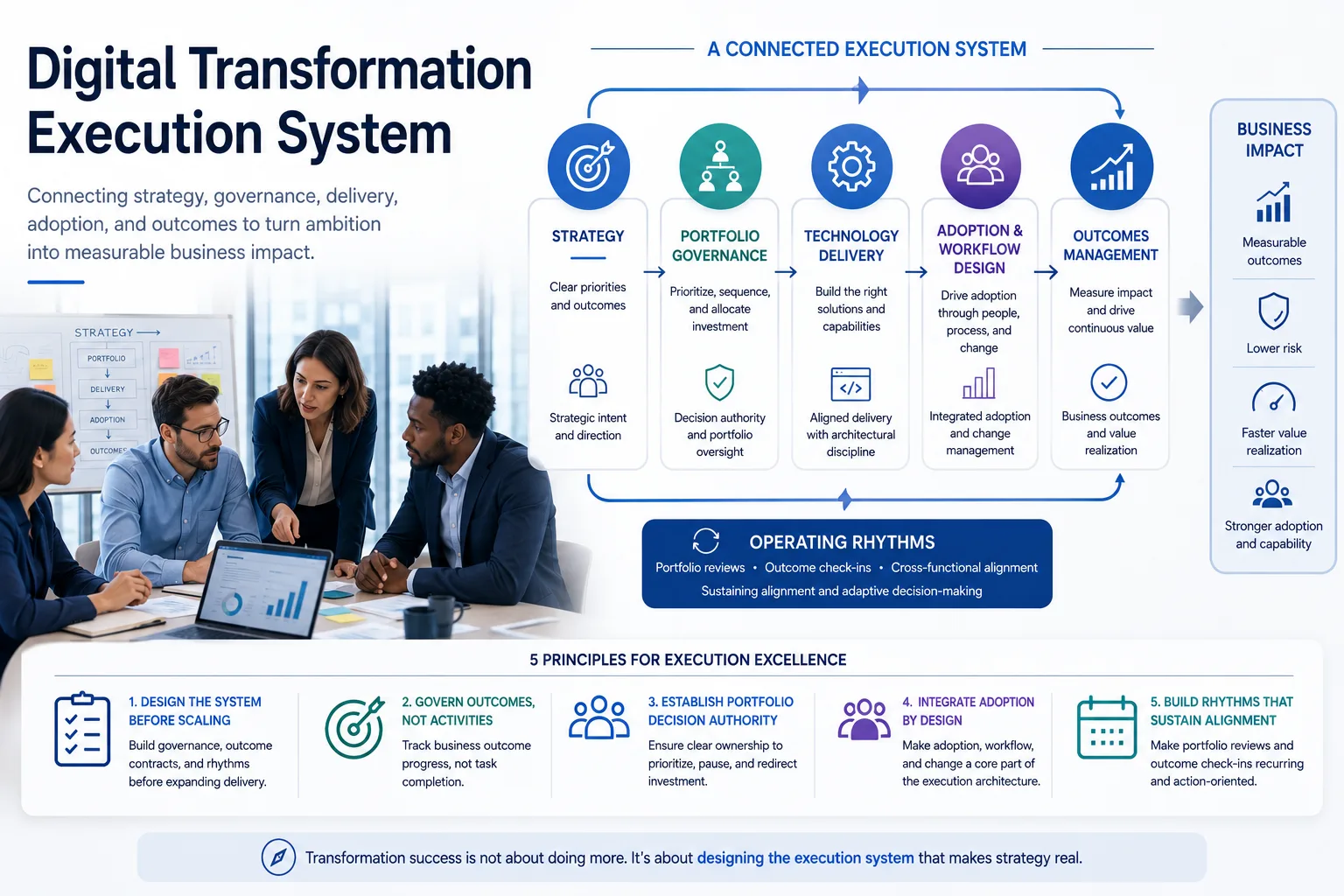
Digital transformation does not fail because organizations set the wrong targets. It fails when the components required to execute — strategy, portfolio governance, technology delivery, change adoption, and business outcome management — are treated as separate workstreams rather than as parts of a single execution system. Without the connective tissue, each component can perform reasonably well on its own terms while the transformation as a whole produces nothing measurable.
Why Digital Transformation Loses Momentum
The pattern is consistent across industries. A transformation program is launched with executive commitment and strategic clarity. Early initiatives show promising results. Momentum builds.
Then the organization hits the integration layer. The strategy was designed by one team. Technology delivery is owned by another. Business adoption sits with HR or change management. Outcome measurement was not specified clearly at the start. Nobody owns the question of whether the program is actually delivering what it promised.
Research from McKinsey on digital transformations consistently shows that fewer than a third of digital transformation programs achieve their stated objectives. The gap is almost never in strategy quality. It is in the organizational machinery required to execute strategy continuously, under real operational conditions, over a multi-year horizon.
Momentum breaks down when the execution system is missing — when there is no governance mechanism that keeps strategy connected to delivery, delivery connected to adoption, and adoption connected to outcomes.
The Gap Between Strategy and Execution
The most dangerous gap in digital transformation is not the technology gap. It is the translation gap between strategic intent and operational reality.
A strategy that says “become a data-driven organization” must be translated into specific portfolio decisions, technology investments, capability builds, workflow redesigns, and measurable business targets. Each translation step is an opportunity for fidelity loss. By the time strategic intent reaches the teams doing the work, it often arrives as a vague mandate with no clear definition of success.
This translation problem is compounded by governance structures that were not designed for transformation. Traditional project governance treats transformation initiatives as large, discrete projects with fixed scope and delivery dates. Transformation is neither discrete nor fixed. It requires portfolio-level decision-making, adaptive resource allocation, and outcome-based prioritization that most project management offices were never designed to support.
The OECD’s analysis of digital government and enterprise transformation identifies governance design and institutional coordination — not technology capability — as the primary determinants of transformation effectiveness. The same pattern applies in enterprise settings.
What an Execution System Requires
An execution system for digital transformation is not a methodology or a framework. It is an organizational design — a set of connected structures, processes, and rhythms that keep strategy, delivery, adoption, and outcomes aligned across the life of the program.
Portfolio governance with real decision authority. Transformation investments must be managed at the portfolio level, not project by project. This requires a governance function with the authority to prioritize, sequence, pause, and redirect investments based on strategic fit and business outcomes — not just delivery progress.
Outcome contracts, not activity plans. Each transformation initiative should be governed against specific, measurable business outcomes — commercial, operational, or risk-related. Activity plans tell you what teams are doing. Outcome contracts tell you whether the program is working.
Architecture connecting delivery and strategy. Technology delivery must be connected to strategic intent at the design level, not just at the reporting level. When delivery teams operate without a clear line of sight to strategic priorities, they optimize locally and sub-optimize the program.
Integrated adoption and workflow redesign. Technology deployment without adoption design delivers capability that organizations cannot use. Adoption must be built into the execution system as a design discipline — not added after delivery is complete.
Operating rhythms that sustain alignment. Execution systems are sustained by recurring rhythms: portfolio reviews, outcome check-ins, cross-functional alignment forums. Without these rhythms, strategy and delivery drift apart over time as operational pressures accumulate.
How Leaders Should Govern Transformation
Transformation governance fails in one of two directions. The first is under-governance: initiatives proceed without strategic alignment, outcome targets, or portfolio-level visibility. The second is over-governance: programs become so burdened with reporting, committee reviews, and escalation requirements that delivery velocity collapses.
Effective governance for transformation finds the operating point between accountability and agility. That means:
Governing outcomes, not activities. Review mechanisms should track whether transformation initiatives are delivering against business targets, not whether teams are completing planned tasks. Activity completion is a lagging indicator of organizational busyness. Outcome progress is the leading indicator of transformation value.
Separating portfolio governance from delivery governance. Portfolio governance operates at the strategic level — prioritizing, sequencing, and reallocating investment across initiatives. Delivery governance operates at the program level — removing impediments, managing dependencies, sustaining pace. Conflating the two leads to governance bodies that are too slow for delivery decisions and too operational for strategic ones.
Creating explicit decision rights. Who decides when to scale an initiative? Who decides when to stop one? Who owns the question of whether the portfolio is generating business value? Without explicit decision rights, transformation programs accumulate ambiguity that erodes accountability and slows progress.
For leaders working through these design questions, advisory engagements offer structured support for building the governance architecture that transformation programs require. Related case studies illustrating how execution system design has shaped transformation outcomes are available in the case studies hub.
Where to Start
The right starting point for most organizations is a diagnostic that distinguishes between the components of the execution system that are working and those that are missing or misaligned.
This means asking: Where do strategic priorities connect clearly to active delivery investments? Where does delivery lose sight of business outcomes? Where does adoption sit in the execution architecture — as a design discipline or a deployment afterthought? Where are the governance decision rights clear and where are they contested?
From that diagnostic, the highest-leverage interventions become visible. In most organizations, the most impactful changes are not in technology or strategy — they are in the governance structures and operating rhythms that keep the components of the execution system aligned.
If your transformation program has solid strategy and capable delivery teams but is still not generating the business outcomes you expected, the execution system is almost certainly where the answer lies.
The Digital Transformation insights hub offers additional perspectives on execution, governance, and operating model design. For organizations ready to build the execution architecture their transformation program requires, start a conversation.
Conclusion and Recommendations
Digital transformation is not primarily a technology investment. It is an organizational design challenge. The programs that generate durable business value are the ones that treat transformation as an execution system — connecting strategy, governance, delivery, adoption, and outcomes through deliberate organizational architecture rather than treating them as separate workstreams.
For leaders building or resetting their transformation execution architecture, the following recommendations provide a practical starting framework:
Design the execution system before scaling delivery. Before expanding the transformation portfolio, ensure that the governance structures, outcome contracts, and operating rhythms required to manage it exist. Scaling delivery without execution architecture amplifies fragmentation.
Replace activity governance with outcome governance. Review mechanisms should track business outcome progress, not task completion. Define outcome targets at the initiative level before launch and govern against them throughout.
Establish portfolio-level decision authority. Identify who owns the transformation portfolio at the strategic level — with the authority to prioritize, pause, and redirect investment. Without this, every initiative becomes equal and strategic sequencing is impossible.
Integrate adoption into the execution design. Adoption is not a deployment responsibility. It is a design responsibility. Build workflow redesign, behavioral change, and adoption measurement into the execution architecture from the beginning.
Build governance rhythms that sustain alignment. Portfolio reviews, outcome check-ins, and cross-functional alignment forums must be recurring structures, not one-time events. The execution system is only as strong as the organizational rhythm that sustains it.
These recommendations apply whether the organization is launching a new transformation program or resetting one that has lost momentum. The execution system is what makes the difference.
Explore more perspectives in the Digital Transformation insights hub or browse all strategic insights. For related thinking on AI operating model design, see AI Strategy Needs an Operating Model. For structured support in designing the execution architecture your program requires, advisory engagements are the right starting point.