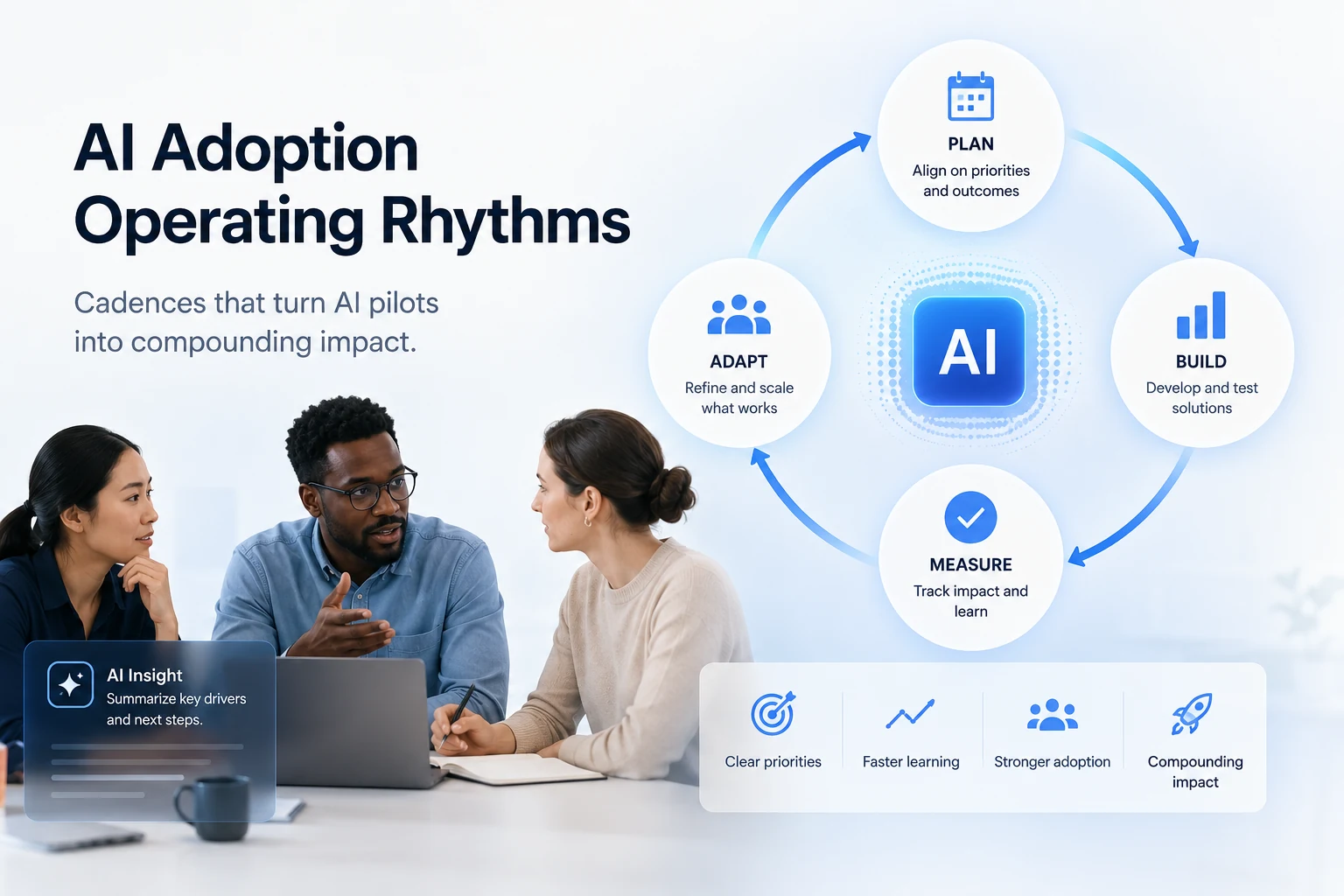
Most organizations underestimate what adoption actually requires. They invest in AI tools, run training sessions, and communicate the change. Then they wait for behavior to shift. It rarely does — not at scale, not durably, not in ways that deliver the business outcomes the investment promised.
The reason is structural. Adoption is treated as a communication and enablement challenge when it is, in fact, an operating design challenge. Changing how people work requires changing the rhythms, routines, and decision structures that govern how work gets done every day. Without that, AI adoption stalls at awareness and never reaches execution.
Why AI Adoption Stalls After the Launch
Every large AI adoption effort has a launch moment. Announcements are made. Platforms are deployed. Training is delivered. And for a brief period, activity metrics look encouraging — logins, usage rates, sessions. Then, quietly, the numbers plateau. Teams continue working in the patterns they know. The AI tools become optional, then peripheral, then forgotten.
This is not a motivation problem. Most teams are willing to adopt new ways of working if those ways are clearly better and fit naturally into how their work is structured. The problem is that the operating context has not changed to support the new behavior.
Research on AI adoption barriers consistently identifies process integration and workflow redesign — not tool quality or user sentiment — as the primary constraints on sustained adoption. When the way AI outputs connect to decisions, handoffs, and workflows remains unclear, adoption stays optional.
Optional is the same as fragile.
Adoption Is an Operating Rhythm, Not a Campaign
The organizations that achieve durable AI adoption share one structural pattern: they built adoption into how the organization operates — not into a launch event.
This means AI use is embedded into recurring routines — daily standups, weekly operating reviews, team rituals, decision-making frameworks. When AI outputs appear in the meeting agenda, the planning process, or the escalation criteria, adoption shifts from a choice to a default. The tool becomes part of the operating system, not an add-on.
Operating rhythms matter because human behavior is shaped by context far more than by intention. A leader who attends a training session and understands the tool may still not change how they prepare for a meeting. But a leader whose team meeting structure now expects AI-informed analysis will change behavior because the operating context demands it.
This is why MIT Sloan research on digital behavior change frames workflow redesign as the central lever for sustainable adoption — not upskilling, not change communications, not executive sponsorship alone.
Embedding AI into operating rhythms is how organizations convert willingness into practice.
What Leaders Need to Reinforce
Sustainable adoption requires active reinforcement from leaders at every level, not just visible sponsorship at the top.
Model the behavior visibly. When leaders use AI-informed insights in their own decision-making and make that visible to their teams, adoption becomes a norm rather than an obligation. Leadership behavior is the most credible signal of organizational priority.
Redesign workflows explicitly. Generic enablement — training followed by access — is not enough. Teams need to understand specifically how AI fits into their work: which tasks it changes, which decisions it informs, which handoffs it affects. Workflow redesign is the translation layer between technology availability and operational change.
Remove friction from integration. Adoption stalls when AI tools require extra steps, separate logins, or workflows that sit outside the core platforms teams already use. Integration into existing tools and processes reduces the friction cost of new behavior.
Create accountability for adoption outcomes. Adoption targets should sit alongside business outcomes in operating reviews. If no one is accountable for whether AI is actually changing how work gets done, the pressure to sustain the change dissipates after launch.
How to Measure Adoption Beyond Activity
Activity metrics — logins, sessions, feature usage — are necessary but not sufficient for understanding whether adoption is working. They tell you that people are using the tool. They do not tell you whether the tool is changing how work gets done or whether that change is generating business value.
A more complete measurement framework distinguishes three levels:
Behavioral adoption — are people using AI outputs to make decisions, not just exploring the tool? This requires observing whether behavior in meetings, planning processes, and workflow handoffs has actually changed.
Process adoption — have workflows been redesigned to embed AI as a standard input rather than an optional supplement? This is visible in process documentation, operating norms, and how teams describe their own working practices.
Outcome adoption — are the business outcomes that motivated the AI investment improving? Adoption that does not ultimately connect to commercial, operational, or risk outcomes is activity without impact.
Most adoption dashboards stop at the first level. Leaders who manage all three build a much clearer picture of where adoption is compounding and where it is stalling.
Where to Start
For most organizations, the right starting point is not more training or more communication. It is a clear diagnosis of where adoption is fragmented.
This means identifying the specific workflows and decision points where AI should change how work gets done — and assessing whether those workflows have actually been redesigned, whether leaders are reinforcing the new behavior, and whether there are operating rhythms in place to sustain the change over time.
If the answer to most of those questions is no, the adoption program needs structural redesign, not a new enablement campaign.
Advisory engagements focused on AI adoption begin with exactly this kind of diagnostic — mapping the gap between technology availability and behavioral change, and building the operating design that bridges it. For context on how this work connects to broader transformation, the AI Adoption insights hub offers additional perspectives. If you are ready to explore what this looks like in your organization, start a conversation.
Conclusion and Recommendations
AI adoption is not primarily a technology challenge or a training challenge. It is an operating design challenge. Organizations that build AI into their operating rhythms — their recurring routines, workflow structures, and decision-making processes — achieve durable behavioral change. Organizations that rely on launch events and enablement campaigns plateau at awareness.
For leaders building or rebuilding an AI adoption program, the following recommendations provide a practical starting framework:
Redesign workflows before expanding access. Identify the specific decisions and handoffs where AI should change how work gets done, and redesign those workflows explicitly. Generic access without workflow context produces activity without adoption.
Embed AI into recurring operating rhythms. Meeting structures, planning processes, and decision criteria should be updated to include AI-informed inputs as a standard expectation, not an optional resource.
Require leaders to model the behavior. Visible leadership behavior is the most credible organizational signal. Leaders who use AI in their own decision-making and make that visible accelerate adoption faster than any training program.
Build a three-level measurement framework. Track behavioral adoption, process adoption, and outcome adoption — not just activity metrics. Know where adoption is compounding and where it is stalling.
Make adoption a portfolio management responsibility. Adoption targets and outcomes should be reviewed at the operating level alongside business outcomes. When no one is accountable, adoption erodes quietly.
These are not technology recommendations. They are the organizational design principles that determine whether AI investments generate compounding value or scattered activity.
Explore more perspectives in the AI Adoption insights hub or browse all strategic insights. For related thinking on how operating model design shapes AI strategy outcomes, see AI Strategy Needs an Operating Model. For organizations ready to act on transformation, advisory engagements are designed to support exactly this kind of structural work.