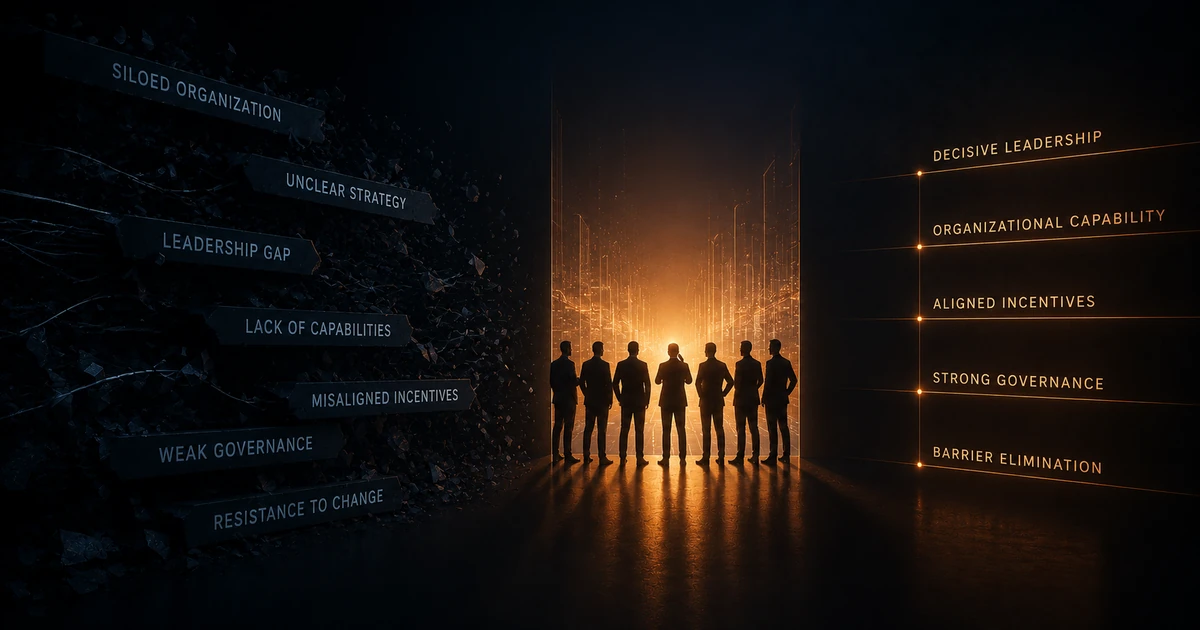
Digital transformation programs fail at a predictable point. Not at the technology layer — systems are deployed, platforms are launched, integrations are completed on schedule. They fail at the organizational layer: the new capabilities sit unused, the redesigned workflows revert to old patterns, and the operating model that was supposed to change remains structurally identical to the one the transformation was designed to replace. The investment is made. The change does not stick.
The consistent explanation for this pattern is not poor execution. It is that organizational readiness was assumed rather than designed. Leaders approved the transformation roadmap, allocated the budget, and launched the program without establishing the structural conditions that determine whether an organization can absorb, adopt, and sustain the changes the transformation requires. When those conditions are absent, even well-executed transformation programs deliver capability without behavioral change — technology without transformation.
This is the readiness gap. And it is a design problem, not a communication problem.
What Organizational Readiness Actually Means
Organizational readiness is frequently conflated with enthusiasm. Stakeholder surveys show high positive sentiment. Leadership communicates the transformation vision. Training completion rates are tracked as evidence of preparation. These activities are not irrelevant — but they measure the wrong thing.
Readiness is the structural capacity of an organization to absorb, adopt, and sustain the changes the transformation requires. It is not a feeling about the transformation. It is not the percentage of employees who have attended an awareness session. It is a set of structural conditions — clarity of direction, decision authority, capacity allocation, leadership alignment, removal of competing incentives — that determine whether behavioral change is possible once new capabilities are deployed.
An organization with high enthusiasm and low structural readiness will generate significant activity in the early phases of transformation and then stall when the gap between what the transformation requires and what the structure enables becomes impossible to ignore. Leaders will recognize the pattern: the program was embraced in principle but resisted in practice. The problem is not that people were unwilling. The problem is that the structure never made the new behaviors the path of least resistance.
Readiness assessments that focus only on sentiment produce a false positive. The relevant questions are structural: does the organization have the decision authority aligned to the required changes? Have conflicting incentives been removed or rebalanced? Is there capacity — time, attention, cognitive bandwidth — available for adoption alongside business-as-usual operations? Has leadership alignment been established at the level of specific behavioral expectations, not just stated support?
If these conditions are not in place before execution investments begin, the transformation is being built on an unstable foundation.
The Leader as Architect of Change
The most consequential misconception in transformation leadership is that the leader’s job is to champion the transformation — to communicate the vision, build enthusiasm, and demonstrate personal commitment. This is not wrong. But it is incomplete in ways that explain why transformation programs with visible and committed sponsors still fail to deliver.
The leader’s primary structural function in a transformation program is not to advocate for change. It is to design the conditions in which change can happen. This is an architectural role, not a communications role.
Designing those conditions means making specific decisions that are harder than messaging: realigning decision rights so that the teams responsible for driving adoption have the authority to resolve the conflicts that adoption creates. Adjusting resource allocation so that transformation work has genuine priority rather than theoretical priority that collapses under business-as-usual pressure. Setting the sequencing and pace of the program to match the organization’s actual absorption capacity rather than an aspirational timeline that assumes full readiness. Making leadership alignment visible not through endorsement but through consistent behavior when the transformation creates friction with existing priorities.
Leaders who design these structural conditions early create programs where adoption happens naturally, because the organization’s structure supports it. Leaders who focus on advocacy without addressing structure create programs where adoption requires constant individual effort to overcome structural barriers — effort that is unsustainable over the duration of a multi-year transformation.
The diagnostic question for any transformation sponsor is simple: have I changed the structure, or have I communicated about change?
Why Resistance Is a Design Problem
The standard framing of resistance to change treats it as a behavioral problem — a function of individual psychology, cultural inertia, or insufficient communication. This framing leads to solutions that address symptoms: more messaging, more engagement sessions, more visible leadership endorsement.
A more useful framing treats resistance as information. McKinsey research on transformation outcomes consistently finds that people-related factors — not technology — are the primary source of transformation failure; and in most cases those factors trace back to structural design choices, not individual resistance. When a transformation program encounters sustained resistance, that resistance is signaling something specific about the program’s design.
Resistance concentrated in a specific function typically signals a scope or ownership problem: the transformation is redesigning how that function works without giving it meaningful ownership of the redesign. Resistance that appears after initial adoption often signals a capacity problem: the organization adopted the new capability during a supported transition period but cannot sustain adoption when normal operating pressure returns. Resistance at the leadership layer frequently signals a sequencing problem: the program is asking the organization to change behaviors that the existing incentive structure does not reward, or that the existing decision structure does not enable.
In each case, the response to resistance is not better communication. It is a diagnosis of what the resistance is revealing about program design — and a structural correction. This requires the transformation sponsor to treat resistance data as program intelligence rather than as evidence of a people problem that change management should resolve.
This shift in framing is significant. It moves accountability for adoption from the change management workstream — which typically has no authority to change program structure — to the program governance structure, where design decisions are actually made. And it changes what success looks like: not the elimination of resistance, but the ability to read resistance accurately and use it to improve the program design in real time.
Building the Structural Conditions for Cultural Change
Cultural change in organizations does not happen through culture initiatives. It happens through structural interventions that make new behaviors more viable than old behaviors over a sustained period.
The structural interventions that consistently shape organizational behavior in transformation programs operate across four dimensions.
Clarity of direction at the behavioral level. Strategic intent does not change behavior. Specific, observable expectations about how people should work differently — what decisions look like, what gets escalated and what gets resolved locally — create the behavioral reference points that make cultural change possible. Vague aspirations about collaboration or innovation have no structural effect.
Visible leadership alignment on the hard cases. Leadership alignment is tested not in communications but in decisions. When the transformation requires a tradeoff between transformation priorities and short-term operational performance, does leadership make the decision that supports the transformation? Consistency on the hard cases is the evidence that changes behavior at scale; inconsistency signals that the transformation is optional.
Removal of structural barriers before adoption is required. Many programs ask teams to adopt new ways of working while conflicting reporting lines, unredesigned processes, and unresolved decision authorities remain in place. Adoption under those conditions requires individuals to solve structural problems through personal effort — an approach that is not sustainable over a multi-year program. Remove the barriers first, then require adoption.
Capability investment before adoption requirements. Requiring new behaviors without building the capability to execute them produces compliance theater rather than genuine adoption. Technical training, operating model enablement, and decision-making support must precede the point at which adoption is measured and held to account.
Research on what distinguishes successful digital transformations consistently identifies these structural interventions — behavioral clarity, capability investment and removal of structural barriers — rather than communication campaigns, as the primary drivers of sustained behavioral adoption.
Change Leadership as a Governance Function
The most persistent structural weakness in transformation programs is the positioning of change management as a workstream — a communications and engagement function that runs alongside the program and delivers outputs like stakeholder maps, communication plans, and training completions.
This positioning misrepresents what effective change management does and systematically underequips it to do it. A change management workstream that sits adjacent to program governance cannot redesign the program when adoption data reveals structural problems. It can communicate about the program. It can surface resistance. But it cannot change the structural conditions that generate resistance, because those decisions live in the governance structure, not the communications function.
Effective change management is a governance capability. It operates within the transformation governance structure — with visibility into program design decisions, authority to surface adoption risk at the portfolio level, and the ability to escalate structural issues to the decision-makers who can act on them. It uses adoption data not to produce engagement metrics but to inform sequencing decisions, resource allocation, and structural redesign.
Change leadership — the person or function responsible for organizational readiness and adoption — requires a governance role, not just an advisory role. They need to be present in the forums where program design decisions are made, with standing to challenge design choices that create adoption risk. Positioning change management outside those forums produces a function that describes the organizational impact of decisions made without it.
Where to Start
For transformation sponsors who want to assess whether organizational readiness has been designed into the program or assumed, three structural questions provide the most diagnostic value.
First: Is there a named accountable owner for adoption outcomes — not activity — at each stage of the transformation? Not a change management workstream responsible for communications, but a leader or governance body with clear accountability for whether the organization is actually adopting what the transformation deploys. If accountability for adoption is distributed or unclear, adoption failure will also be distributed and unclear, which means it will go unaddressed until it becomes undeniable.
Second: Have the structural barriers to adoption been inventoried and scheduled for removal before adoption is required? A structural barrier inventory examines decision rights, incentive structures, competing priorities, process dependencies, and capability gaps — and maps each to the point in the transformation timeline where it will prevent adoption if not addressed. If this inventory does not exist, the program is assuming that the path is clear when it may not be.
Third: Does the transformation governance structure include regular reviews of adoption data that connect directly to program design decisions? If adoption metrics are tracked in a separate change management report that feeds into program reviews as an informational item, the feedback loop is broken. If adoption data influences sequencing decisions, triggers structural redesign, and surfaces in portfolio governance as a leading indicator of program health, the loop is functional.
These three questions surface whether organizational readiness has been designed in as a structural property of the program — or treated as a condition that communication and engagement will produce.
If these questions reveal that the foundational strategic decisions — scope, operating model intent, capability investment sequence and governance authority — were not made explicitly before the program began, the companion work is ensuring those decisions are addressed as quickly as possible. See Digital Transformation Strategy Design for a structured approach to making those foundational decisions — and the diagnostic signals that indicate when the strategy design is ready for execution.
Advisory engagements focused on digital transformation readiness help organizations establish the structural conditions, governance accountability, and adoption architecture that make transformation investment productive — before execution begins, or when a program in progress is encountering sustained resistance. If the diagnostic questions above reveal design gaps in your program, start a conversation.
Conclusion and Recommendations
Digital transformation fails at the organizational layer when readiness is assumed rather than designed. The technology works. The new operating model exists on paper. But the structural conditions that make adoption possible — clear behavioral expectations, aligned decision authority, removed structural barriers, capable teams, and governance that treats adoption as a program design question — were never established.
The remediation is architectural. Change management must be elevated from a communications function to a governance capability. Leaders must shift from championing the transformation to designing the conditions for it. Resistance must be read as design intelligence rather than treated as a people problem.
For leaders governing or sponsoring transformation programs, the following recommendations address the structural conditions that determine whether transformation sticks:
Assess organizational readiness formally before committing the transformation budget. Run a structural readiness assessment — covering decision authority, competing incentives, leadership alignment, and absorption capacity — before the roadmap is finalized. Readiness gaps are program constraints, not soft risks; treat them as such in the plan.
Name a specific leader accountable for adoption outcomes at each transformation stage — not for communications, for outcomes. That accountability must appear in the governance structure alongside delivery and budget accountability. If adoption performance has no named owner, it will drift until the gap becomes undeniable.
Produce a structural barrier inventory before each adoption milestone. Map every decision right, incentive, process dependency, and capability gap that will block adoption at that milestone. Schedule the removal of each barrier before the adoption requirement activates — not concurrently, before.
Seat the change leadership function inside program design forums, with standing to challenge sequencing and structural decisions. A change leader with observation rights but no design authority cannot correct the structural conditions that generate adoption failure. Standing matters — advisory access without it produces reports, not corrections.
When resistance concentrates in a function or leadership level, map it to its structural cause before designing a response. Sustained resistance in a specific area almost always signals a scope, ownership, or sequencing problem in the program design. Investigate the design before escalating engagement activity — communication addressed to a structural problem does not solve it.
Confirm that capability investment precedes adoption measurement — not follows it. Before each transformation phase goes live, verify that teams have the training, tools, and decision support to perform the new behaviors. Measuring adoption before capability is in place produces compliance theater, erodes program credibility, and generates resistance that was entirely avoidable.
Explore more perspectives in the Digital Transformation insights hub or browse all strategic insights. For related thinking on how execution discipline and governance structure determine transformation outcomes, see Digital Transformation Is an Execution System. If you are ready to discuss the structural conditions for transformation in your organization, start a conversation.